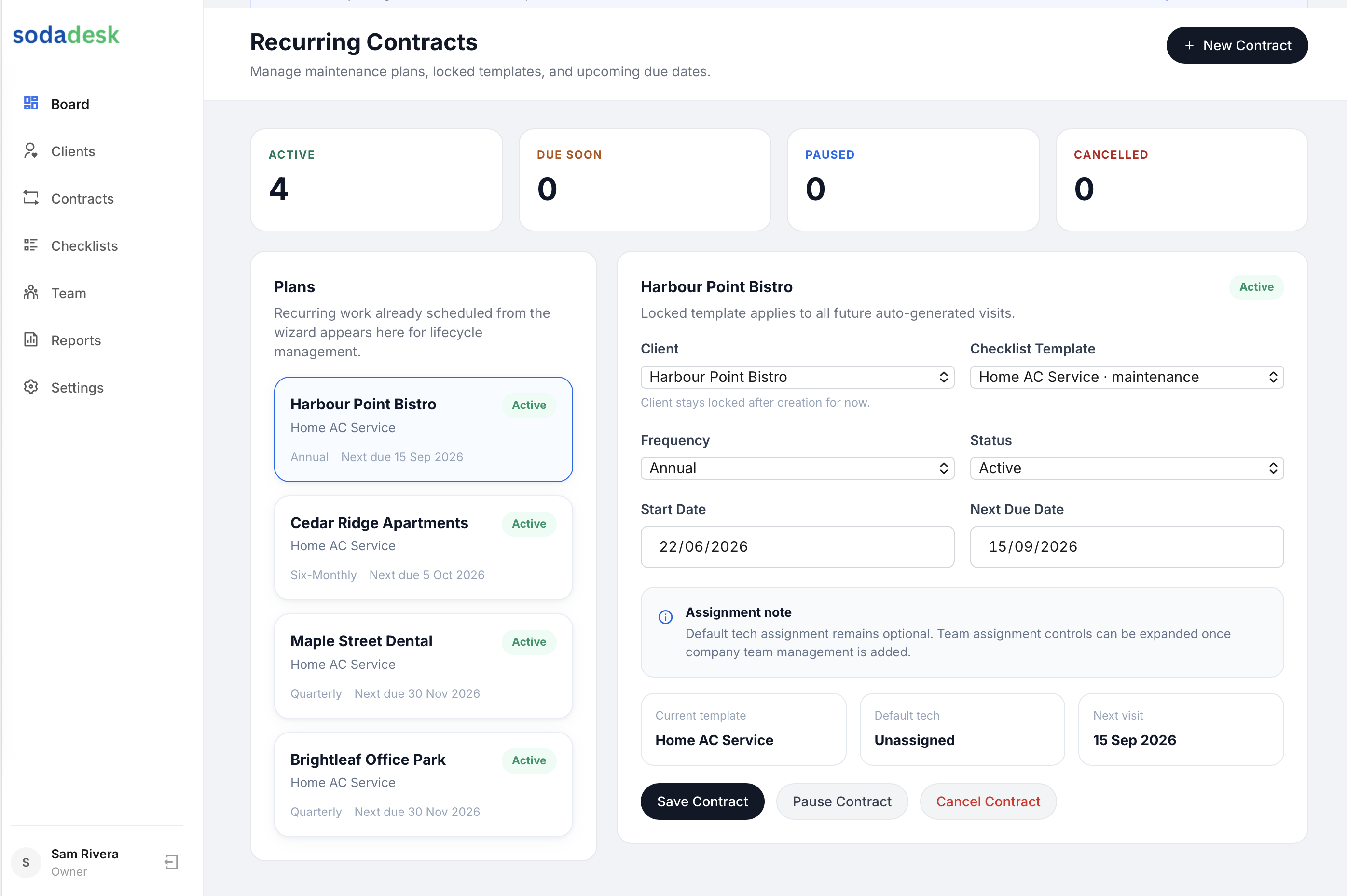
The real problem with recurring HVAC visits
Most owners don’t lose sleep over one tune-up. They lose sleep over the ones that disappear into the cracks. The tech says he was there. The customer says the rooftop never got touched. The office has a calendar reminder, a rough note, and maybe a text thread that nobody wants to read twice.
That’s where recurring service contracts get sloppy. Not because the work didn’t happen. Because the record didn’t follow the work.
If you run maintenance agreements on air handlers, package units, split systems, and RTUs, you already know the drill. Spring visits turn into condenser cleanings, capacitor checks, contactor inspections, belt checks, and a quick look at the drain line. Fall visits mean heat strip testing, gas pressure on furnace jobs, flame sensor cleanup, and a filter swap if the customer pays for it. And every one of those visits needs a clean paper trail.
Not a story. A record.
What a good service record actually shows
A real maintenance record should answer a few plain questions.
Who was there?
What time did they get on site?
What got checked?
What got replaced?
What did the equipment look like before and after?
Did the customer know the visit happened?
If you’re managing recurring HVAC maintenance visits, that’s the whole game. The work itself matters, sure. But the record is what keeps the contract from turning into a he said, she said situation later.
SodaDesk keeps the focus on that record. The tech checks in with GPS, so you know the visit started at the site, not in the truck down the road. The time on site is captured. The checklist gets completed. Photos get attached. And if you want it, the customer signs at the end.
That sounds basic because it is. Basic is good. Basic is what keeps you out of trouble with your own notes.
What I’d want on every maintenance stop
If I were running a shop and using recurring service agreement software, I’d make every tech leave the same proof package every time. Not because I like paperwork. Because I’ve seen what happens when the details get fuzzy.
For a typical HVAC maintenance visit, I’d want:
- arrival check in with location
- departure time on site
- unit model or equipment ID
- suction and discharge readings where they matter
- subcooling and superheat on cooling calls
- supply and return temps
- filter size and condition
- belt condition if there’s a belt drive
- capacitor reading if the tech checked it
- burner or flame inspection notes on heat calls
- condensate drain condition
- before and after photos
- customer signature if the visit needs one
You don’t need a 40 item form for every job. But you do need enough to show the visit was real and the work matched the contract.
That’s the part a lot of shops miss when they ask how to automate recurring HVAC maintenance visits. They focus on the reminder. The reminder is the easy part. The record is where the value lives.
A simple example from a real maintenance contract
Say you’ve got a five ton rooftop unit on a small office building. The contract says spring and fall service.
The tech gets there on a Tuesday morning. He checks in from the site. The system logs the time. He opens the panel, finds a dirty filter, a loose belt, and a condenser coil loaded up with cottonwood fluff. He takes a photo before cleaning. Then he washes the coil, checks the belt tension, writes down the amperage draw, and verifies the unit is running within normal range for that day.
If the customer calls two months later and says nobody serviced the unit, you’re not digging through memory. You’ve got the check in time, the checklist, the photos, and the time on site. You can tell them exactly who did the visit and what got done.
That matters even more when you’ve got multiple maintenance agreements on the same property. Rooftop today. Split system next month. Make-up air unit after that. The customer doesn’t care how many trucks you run. They care that the work got done and you can show it.
Why paper service agreements fall apart
Paper works fine until it doesn’t. Then it really doesn’t.
A tech forgets the form in the truck. Somebody writes the wrong unit number. The filter size is scribbled in the margin. A photo is on a phone that gets replaced. The office scans a sheet and files it in the wrong folder. Now a customer wants proof of last quarter’s visit and you’re piecing together a guess.
That’s a dumb way to run a maintenance business.
With hvac maintenance contract software, you want the same visit history every time. Not a pile of loose notes. A clean record by customer, by site, by unit, by technician. If a contract spans ten months and six visits, you should be able to open it and see what happened on each stop.
And if the same tech keeps servicing the same account, even better. The history is right there. He sees the last subcooling reading, the last photo of the dirty coil, and the note that the drain pan had standing water on the previous visit. That makes the next trip better.
What accountability looks like in the field
This is where the owner side of the business gets real. You’re not trying to babysit good techs. You’re trying to keep the honest ones honest and catch the slop before it turns into a callback.
A check in time tells you the visit happened.
A photo tells you the work wasn’t just marked complete.
A checklist tells you the tech didn’t skip the small stuff.
The signature tells you the customer saw the tech on site.
That’s the kind of trail you want for recurring service visits. Not because you expect trouble on every job. Because when trouble shows up, you want proof without having to go drive the route yourself.
And if a tech only spent eight minutes on a tune-up that should’ve taken forty-five, that time on site record is going to raise a flag fast. You don’t need a lecture from a software brochure. You need to know the job got the attention you paid for.
How maintenance agreements stay organized when the season gets busy
Spring and fall always get crowded. Everybody wants the first warm day or the first cold snap. That’s when recurring plans get messy if you’re relying on memory and office notes.
The trick is to tie each recurring visit to the job record itself. Same customer. Same equipment. Same checklist. Same proof trail every time.
That way, when the office pulls up a contract, they’re not guessing which visit is due next or which one was finished already. They’re looking at the actual visit history. The tech sees it in the field. The owner sees it back at the shop.
If you’ve ever wondered how do hvac companies track maintenance contracts with software, that’s the answer in plain English. You track the visit, not just the promise. You track who showed up, what they did, how long they were there, and what they left behind as proof.
What to record when a visit turns into a problem
Sometimes a maintenance stop turns up a bigger issue. Maybe the condenser fan motor is starting to pull high amps. Maybe the contactor is burnt. Maybe the drain line is clogged hard enough that water is backing up in the pan. That’s not a sales pitch. That’s field reality.
Even if you stop short of any extra work, the record should still say what was found.
I’d want the tech to note:
- visible motor wear
- unusual noise from the blower or condenser fan
- burnt terminals
- dirty evaporator coil
- standing water in the pan
- cracked insulation
- abnormal amp draw
Add photos when it matters. A shot of a burnt wire or a packed coil saves arguments later. It also keeps the next tech from walking in blind.
That’s one reason owners ask for best preventive maintenance contract software or best maintenance contract software. They’re really asking for a clean way to keep track of the work that keeps finding little problems before they become big ones. The software only matters if it leaves a trail you can trust.
A maintenance contract should pay you back in proof
Recurring service agreements are supposed to do two things. Keep customers on a schedule. Keep your shop organized.
If the only thing you get is a reminder, you’re missing most of the value.
The better setup is one where every recurring HVAC visit leaves a full record. Check in. Time on site. Checklist. Photos. Signature. That record is what protects the shop when a customer questions the visit, and it’s what gives your techs a clean history when they come back next season.
That’s the part I’d care about if I were running five trucks or twenty. Not fancy. Just solid proof that the work happened, on site, by the right tech, with the right details left behind.
Common questions
What should be on an HVAC maintenance visit record?
At minimum, I’d want check in time, time on site, technician name, equipment ID, checklist completion, readings like superheat or amp draw where they matter, photos, and a customer signature if you use one.
Why do recurring HVAC service contracts need photo proof?
Because photos show the coil was cleaned, the panel was opened, the belt was checked, or the drain line was cleared. A checkbox alone doesn’t tell the whole story.
How do I track which tech serviced a maintenance agreement?
Use a system that ties the visit to the technician who checked in on site. Then keep the checklist and photos with that visit record.
What’s the biggest mistake shops make with recurring service visits?
They track the reminder but not the proof. Then they know a visit was supposed to happen, but they can’t show who went, when they went, or what got done.
Can recurring service records help with callbacks?
Yes. If a unit comes back with the same issue, the previous visit notes, photos, and readings give you a real starting point instead of a guess.