The problem starts when the story gets fuzzy
Electrical work has a funny way of turning into a memory test. One guy swaps out a breaker, another runs the meter check, and a third swings by later to tighten a lug or clean up the panel door. Then somebody calls back and says the panel cover was left off, or a circuit is still dead, and now you’re trying to figure out who was there and for how long.
If you run 5 to 20 trucks, you already know the real cost. It’s not just the callback. It’s the time spent asking around, the awkward phone call to the customer, and the feeling that you’re guessing instead of knowing. Paper timesheets do not tell you which tech was at the panel at 2:15 PM or who stayed long enough to finish the load test.
Field time tracking matters because it ties the work to a person and a place. Not a vague “worked the afternoon.” A real check in. A real check out. A real record.
A panel job that went sideways
Say you sent one truck to replace a failing breaker and check a tripping circuit in a house panel. The apprentice gets there first and starts pulling the dead front. The senior tech comes in later, tests the circuit with a meter, finds a loose neutral, and fixes it. Before they leave, someone is supposed to snap an after photo of the panel, note the breaker size, and mark the checklist item for the test light and voltage reading.
Then the customer says the living room still flickers. Now you need to know:
- who checked in at the house
- who actually opened the panel
- how long each tech was on site
- whether the after photo shows the breaker positions and wire landing
- whether the checklist says the load test was done
That’s the kind of paper trail that saves you from a bad argument. Not because it makes the customer vanish. It gives you a clean record of what happened.
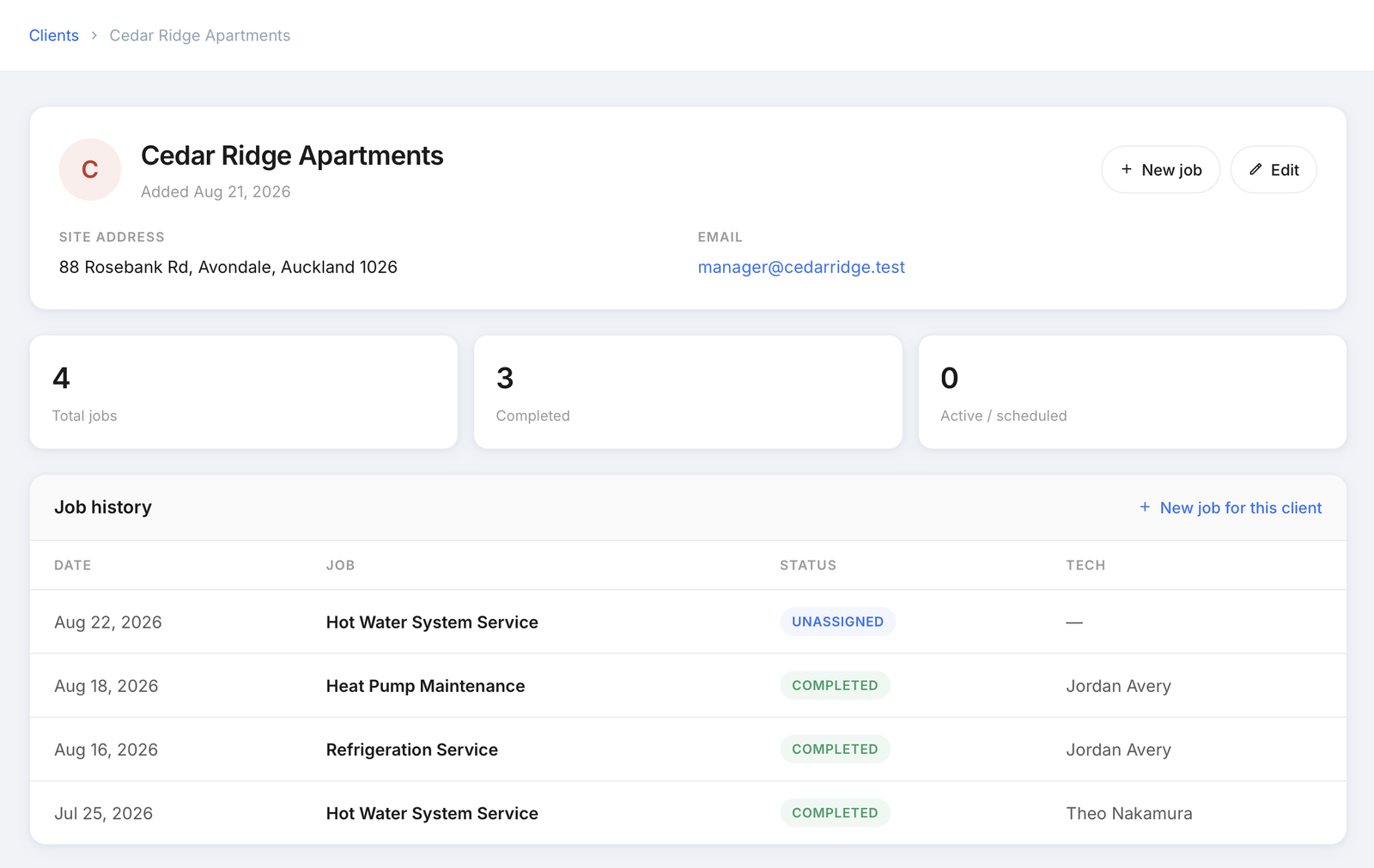
SodaDesk does that part. It stamps the GPS check in, tracks the time on site, and keeps the photos and checklist tied to the visit. So when the office asks who was there, you’re not relying on a greasy notebook or a tech’s memory after dinner.
Why electrical shops feel this more than most
Electrical work often gets split up in ways other trades don’t deal with as much. One truck handles rough-in. Another finishes devices. A service tech handles troubleshooting. And sometimes two people touch the same job because one person is better with a meter and another is quicker with the physical work.
That’s fine. It’s normal. But it gets messy if your time tracking can’t show the handoff.
You don’t need fancy language for that. You need to know:
- who checked in first
- who stayed for the meter test
- who took the after photo of the panel label, breaker layout, or new receptacle
- who completed the checklist on smoke detectors, GFCI checks, or torque notes if that’s part of your process
That record matters on recurring service visits too. Think of the strip mall where your crew comes back every quarter for panel checks, lighting repairs, and general maintenance. If the same issue keeps popping up, you want to see which tech handled the last visit, what they wrote down, and what photo they attached. That beats digging through text messages.
What a good field record actually includes
A lot of owners say they want “better time tracking.” What they really want is proof the work happened. Time is part of it, but not the whole thing.
For electrical jobs, the useful record is plain:
- GPS check in and check out at the site
- time on site for each tech
- before and after photos of the panel, device, fixture, or service area
- a checklist that matches the actual work, like breaker replacement, circuit test, fixture install, or device replacement
- customer signature when the visit is done
If you’re dealing with a service call in a finished house, maybe the tech records 120 volts at the receptacle before the fix and 121 volts after. If it’s a commercial panel, maybe the note says the hot terminal was loose and the breaker was replaced with the correct size. If it’s a lighting job, maybe the photo shows the fixture mounted, lens on, and the area cleaned up.
Those details sound small. They’re not. They’re the difference between “we were there” and “here’s what we did.”
Why timesheets fail in the field
A timesheet tells you what someone says happened. That’s useful right up until it isn’t.
A tech might forget to clock in at the site and fill it in later from the van. Another guy might round up time because he was thinking about the next job. Someone else might write down eight hours on a day where he split time between two service calls and a supply run. None of that makes him a bad employee. It just means the record is loose.
Loose records hurt electrical contractor labor tracking because labor is where the margin disappears first. If you can’t tell who spent three hours on a simple breaker swap, you can’t spot the jobs that keep chewing up labor. And you definitely can’t coach the tech who keeps getting buried on every panel call because he doesn’t document what he found.
Field time tracking with check in, check out, and job proof gives you a cleaner picture. You see if the truck was on site for 45 minutes or two and a half hours. You see who was there with him. You see whether the checklist got finished before they left.
The photo that settles the argument
A good after photo does a lot of work.
On an electrical call, it might show:
- the panel cover back on
- breaker labeling updated
- a new GFCI installed and the indicator light on
- a fixture lit and mounted straight
- the work area cleaned up, with no wire scraps left behind
If a customer says the panel was left open or the cover was scratched, the photo tells the story. If the tech says he finished the receptacle swap but forgot to take the final shot, now you know where the process broke down.
That’s the part owners care about. Not because they love paperwork. Because the photo removes the guesswork.
Recurring service visits need a history, not a hunch
Recurring work is where accountability pays off. A lot of electrical shops service the same accounts again and again. Office buildings. Retail strips. Small manufacturing spaces. Churches. Apartment common areas. The same panels, the same lighting issues, the same worn devices.
If you don’t keep a clean visit history, every return trip starts from zero.
With SodaDesk, each recurring visit carries its own proof. The tech checks in at the site, logs the time, adds the photos, and completes the checklist for that day. If the same ballast keeps failing, you can see the pattern. If a breaker trips every other month, you can see who documented it last time and what they wrote.
That’s a lot better than asking, “Didn’t we already fix this?”
What I’d look for if I were buying time tracking for my shop
If you’re comparing options, ignore the fluff and ask the blunt questions.
Can it show who was on site? Can it tie the clocked time to that job, not just the day? Can a tech attach photos from the panel or device right there in the field? Can you keep a checklist that fits your service work without making the crew hate it? Can it handle a recurring visit without turning into a pile of notes?
And can you look at it at 7 PM after a callback and understand what happened without calling three people?
That’s the real test.
A lot of owners start looking for the best time clock app for electrical contractors because they’re tired of cleaning up bad records. Fair enough. But the clock alone doesn’t settle the hard stuff. The hard stuff is proving who did the work, when they were there, and what got left behind as proof.
A simple rule for the field
If a tech can say he was there, but you can’t prove it, you’re still taking his word for it.
That’s fine on a slow day. It’s not fine when the panel work gets blamed on the wrong tech, or when a repeat call shows up and nobody can remember what was checked the last time. Keep the time, keep the photos, keep the checklist, and keep it tied to the visit. That’s how you stop losing half a day to a sloppy story.
Common questions
What should an electrical field time record include?
At minimum, I’d want GPS check in, time on site, the tech’s name, photos from the job, and a checklist tied to the actual work. For service calls, notes like breaker size, voltage reading, or the condition of the panel matter too.
Why isn’t a regular timesheet enough for electrical contractors?
Because a timesheet only tells you hours. It doesn’t tell you who opened the panel, who did the meter test, or whether the after photo shows the work was finished. When a callback hits, that missing detail turns into a headache.
How do photos and checklists help on electrical service work?
They give you a business record of the visit. A photo of the finished panel, a note on the breaker replacement, and a checklist for the test or cleanup make it clear what got done before the truck left.
Can time tracking help on recurring electrical visits?
Yes. If you service the same site over and over, each visit should have its own time, photos, and checklist. That way you can look back at the last visit and see who handled it and what they found.
What’s the biggest mistake shop owners make with field time tracking?
They rely on late-filled timesheets and memory. That’s where records get fuzzy. If you want accountability, the tech needs to check in, log the time on site, and attach proof while the work is still fresh.