Why the record matters on a water heater call
A water heater job is one of those service calls where the work can look fine from the doorway and still be wrong. The burner lights. The tank is warm. The customer says thanks. Then two days later you find a drip at a dielectric union, a loose flue connection, or a relief valve that never got tested.
If you’re running a small plumbing shop, you already know the pain. The guy who did the job says it was done. The customer says the basement was a mess. You’re left trying to piece it together from memory and a half filled paper ticket.
That’s where a clean job record matters. Not for paperwork’s sake. For proof. You want to know who was on site, how long they were there, what they touched, and what the final readings were. A water heater job should leave a trail you can look at later without guessing.
Start with the basics before touching anything
A proper water heater service starts before the wrench comes out. The tech should note the unit type, fuel source, and condition on arrival. Gas, electric, tank, or tankless. Even if the call is a straight tank swap, that first snapshot matters.
Have the tech record:
- arrival time and departure time
- the model and serial number
- gas or electric type
- tank size, like 40 or 50 gallons
- visible condition on arrival
- any active leaks, rust, or corrosion
And take a photo before work starts. Not a glamour shot. A real one. The front of the heater, the piping, the vent, the pan if there is one, and the surrounding area. If the heater is tucked in a closet, get the clearance and the access too. That gives you a before record if the customer later says the unit was left with a dented jacket or a wet floor.
What to check during the service
A lot of water heater jobs get sloppy because the tech rushes to the “big” part and skips the little things. But the little things are what bite you later.
For a tank water heater, the tech should check and record the following:
- T&P relief valve condition and discharge pipe routing
- thermostat setting
- gas control operation or electric element operation
- burner flame on gas units
- sediment buildup if the tank was flushed
- anode rod condition if it was inspected or replaced
- dielectric unions and fitting leaks
- drain valve condition
- expansion tank condition if present
- venting on gas units
If it’s a gas water heater, note the gas pressure reading if your crew is checking it with a manometer. Record inlet and manifold pressure if that’s part of the job. If the burner is lazy, yellow, or rolling, say so. Don’t just write “checked burner.” That tells me nothing.
If it’s electric, record the element resistance or voltage check if the tech tested it. Note whether one element or both were working. And if the breaker tripped before arrival, put that in the record too. That matters when you’re trying to figure out whether the issue was the heater or the feed.
Don’t skip the flush and the drain details
On a lot of service calls, the flush is the difference between a clean heater and a callback waiting to happen. If the tank was drained, record how much sediment came out. Not in a fancy way. Just plain language. “Heavy sediment at drain start,” or “clear after 10 gallons.”
If the drain valve clogged and the tech had to clear it, note that. If the valve was seized and had to be replaced, take a photo of the new one installed. If the tank was old enough that the drain wouldn’t shut all the way and you had to leave it tagged for replacement, that belongs in the record too.
A good photo set here includes:
- sediment in the bucket or hose discharge
- the drain valve before and after
- any replaced part sitting next to the old one
- the heater after cleanup, with no water on the floor
This is the kind of proof that saves you when a customer says, “Nobody touched the heater.” You’ve got the before and after. You’ve got the time on site. You’ve got the tech name.
Record the parts that actually matter
Water heater work has a handful of parts that come up all the time. If they were inspected, repaired, or replaced, put them in the job record.
Common parts to log:
- T&P relief valve
- anode rod
- drain valve
- gas control valve
- thermocouple or thermopile on some units
- burner assembly components
- upper and lower electric elements
- thermostats
- flex connectors
- dielectric unions
- expansion tank
- flue components
Don’t just write “parts replaced.” That’s lazy. Say what was replaced and why. Example. “Replaced 3/4 inch T&P valve due to discharge leak.” Or “Replaced upper element after open continuity reading.” That’s the kind of note another tech can understand when they open the record later.
And if the job was only an inspection or tune-up, still record the condition of the parts. If the anode rod is heavily eaten up, note it. If the burner chamber has rust flakes, note it. If the vent hood is loose, note it. Those details are the difference between a service visit and a mystery.
Use the checklist as the job gets done
The best checklist is the one the tech actually uses on the truck, not the one buried in a folder back at the shop. Keep it short enough to finish and detailed enough to matter.
A solid water heater checklist should include:
- shut off water, gas, or power as needed
- verify unit type and serial number
- inspect tank, piping, and venting
- test T&P valve
- drain or flush tank
- inspect anode rod if accessed
- check burner, flame, or elements
- confirm temperature setting
- inspect for leaks after restart
- clean work area
- take after photos
- collect customer sign off if that’s your normal process
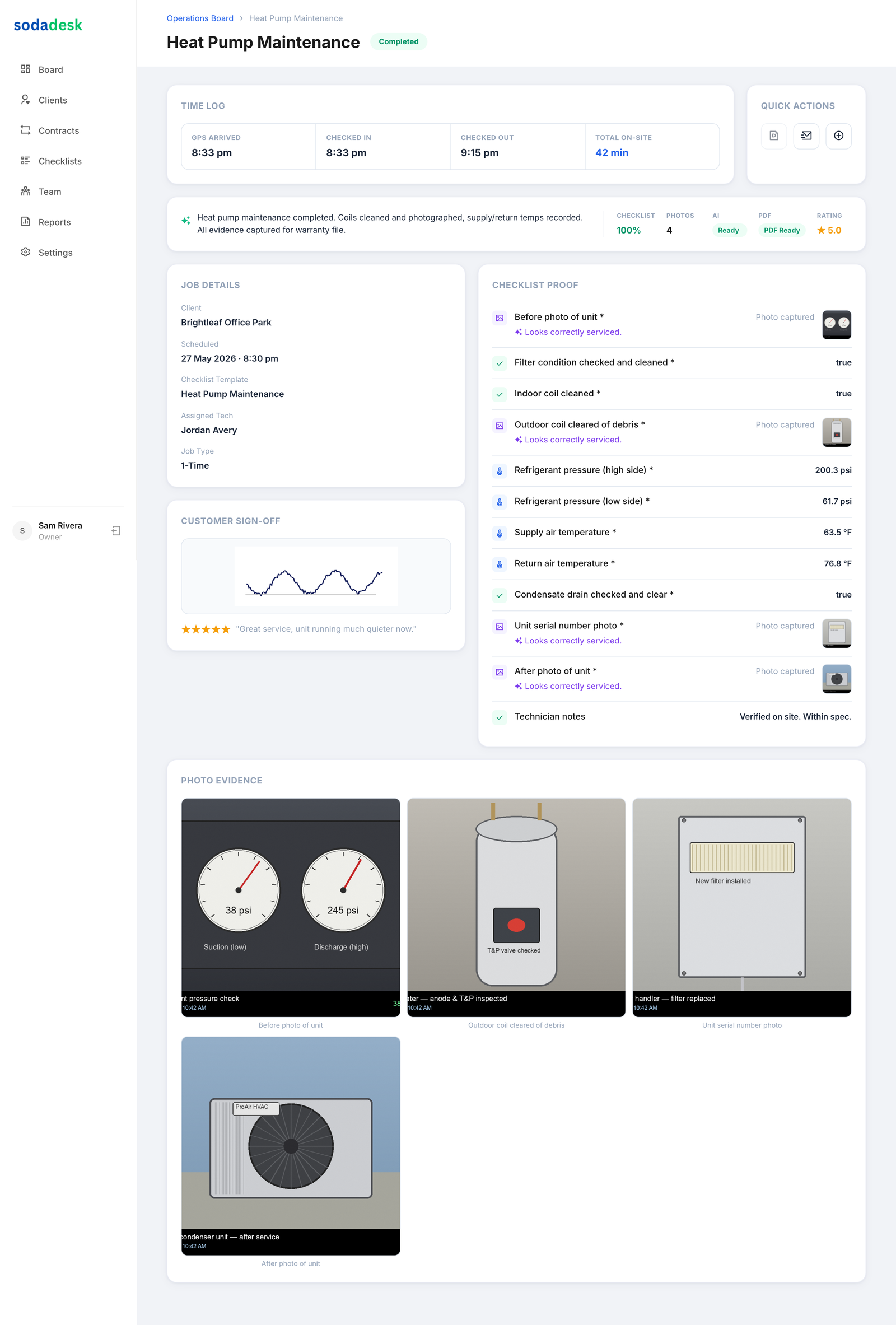
That checklist does two things. It keeps the tech from skipping steps, and it gives you a record that the steps were done. When SodaDesk logs time on site, stamps the check in, and stores the checklist and photos, you’re not relying on memory. You’re looking at the job record.
What a recurring water heater visit should show
Some water heater work repeats. Not every unit, but enough to matter. Maybe you service the same condo building every year. Maybe a commercial kitchen or a small office has a heater you check on a schedule. Same story. You want the old visit and the new visit to tell a story.
For recurring visits, keep the record tied to the unit, not just the day. That means each visit should show:
- who went out
- when they checked in and out
- what condition they found
- what they changed, if anything
- photos from each visit
- any note about the next visit or follow up
Say a tech finds mineral buildup around a drain valve this spring and cleans it up. Then next winter another tech sees the same spot dripping again. If the first visit has good notes and photos, you know this heater has a recurring issue. Maybe the valve is failing. Maybe the tank is near the end. Either way, you’re not starting from zero.
A simple example from the field
Say your tech gets called to a 50 gallon gas water heater in a basement. Customer says the water went lukewarm. Tech checks the unit, finds a weak burner flame, notices sediment in the tank, and confirms the T&P valve is weeping. He flushes the tank, replaces the T&P valve, tightens a loose union, and resets the thermostat to 120 degrees Fahrenheit.
Now think about the record.
It should show the check in time. It should show the tech who did the work. It should show the photos before and after. It should list the gas pressure reading if taken, the water temp setting, and the parts replaced. It should include the checklist items marked complete. And it should show that the tech spent enough time on site to actually do the job.
If that record is thin, you’ve got nothing when the next guy shows up and finds the same heater acting up. If it’s complete, you know what happened and who did it.
What owners should look for in the final record
When the job is over, don’t just ask, “Did it get done?” Ask what the record shows.
You want to see:
- tech name
- arrival and departure time
- job site photos
- checklist completion
- parts used or replaced
- readings taken
- customer sign off if you use it
That’s the whole point. You’re building a business record of the visit. If a customer calls back, you can open it and see what happened instead of calling the tech and hoping he remembers the details.
Honestly, paper tickets are a bad place to trust a water heater job. They get wet, they get lost, and they never tell the whole story. A good digital record does what a scrap of paper never will. It shows the work, the time, and the proof that the heater was handled the way you wanted it handled.
Common questions
What should a water heater service record include?
It should show the tech name, check in and out times, the heater type and serial number, photos before and after, checklist completion, parts replaced, and any readings taken like gas pressure or temperature setting.
Do I need photos for every water heater job?
Yes. At minimum, get a before photo, an after photo, and a close up of any part replaced. If there was sediment, a leak, or a venting issue, photograph that too.
What readings matter on a gas water heater?
If your tech is checking them, record inlet and manifold gas pressure, thermostat setting, and whether the flame looked clean or lazy. Those notes matter when you’re sorting out a callback.
What if the job is just a routine visit?
Still record who went, how long they were there, the condition of the heater, what they checked, and any wear like rust, sediment, or a tired T&P valve.
How does SodaDesk fit a water heater job record?
SodaDesk stamps the check in and out times, stores the checklist, keeps the photos with the job, and ties the work to the technician who did it.